


Our core identities were formed long before we knew how to interpret what was happening around us. At what point do these old definitions stop describing us and start limiting who we’re becoming?
Most of us know at least one person we’d avoid taking a vacation with at all costs. And it’s not because they’re a bad person. It’s because they would meticulously plan every detail, including bathroom breaks, with no room for anyone else’s opinion. To put it lightly, planning a vacation like it’s a military campaign can put people just a little on edge.
Personally, I am a free spirit on vacation. Untethered from restraint, finances, or the concept of a breakfast reservation. But, when it comes to my daily life, oh man do I have a plan. I’m rarely a “one-step-at-a-time person.” I’m a “here’s the entire map, AND I made a topographic map too, just in case” person.
I don’t plan because I want to wreak havoc on someone else’s day. Nobody likes a dictator. But, for me, plans create a sense of safety. Which means that sometimes a disruption feels less like a minor inconvenience and more like a complete implosion.
So, I call myself a planner, but sometimes what I really mean is “I need to know what’s gonna happen for me to feel okay.”
Sometimes labels are really just euphemisms.
I’m not just a planner. I have other labels too. I’m also independent, kind, blunt, curious, ambitious, and a bit of a perfectionist, among other things. And all of those labels mean something to me.
“I’m easygoing” can also mean I learned that expressing my needs creates friction.
“I’m loyal” can also mean I’m scared the people I love will leave me.
“I have high standards” can also mean I was taught that love was based on performance.
These are not binary definitions. You’re not completely carefree or continually suppressing your needs for others. But, the identities we define ourselves by usually reveal something deeper. What do we need? What do we value? What do we think we deserve?
For me, being analytical and planning has practical applications. But, it’s also my way of trying to create a scenario where I can anticipate everything, so I feel safe. It’s not all bad, but it gets heavy when I don’t separate my skill (planning) from my belief (I must know what’s going to happen or I’m in danger).
And the real reason I define myself as a planner isn’t because of what I actually need today. It’s because of what I needed in the past.
Essentially, I’m rooting one of my core identities in a collection of experiences that happened decades ago. And, the cherry on top is that I’m still living as if it’s the present moment. The more I define myself as a planner, the more intense the connection between preparation and safety becomes. At this point, it’s as if I’ve made a contract with myself that I need to plan to feel safe.
The deals we make with ourselves.
News to nobody: Our childhood has a massive impact on our beliefs, emotions, and behavior patterns! Things that seemed true when we were younger, even if they came from a one-off experience, quickly become rules. And rules become facts. And facts become unspoken contracts we live by.
After a lot of reading and a few visits with the therapy fairy, I’ve discovered a whole list of contracts I’d made with myself:
Anything less than 9/10 is average. And I can’t be average, or nobody will see me.
If anything goes wrong, it’s because I am inherently incapable. If I were capable, it wouldn’t have gone wrong.
Great self-talk, right?
I’ll spare you the “everything is our parents’ fault” tirade (because there’s no need to argue facts), but a lot of our self-talk comes from those childhood experiences. That doesn’t mean you can’t change it, but I’m personally convinced that monologue will always be in my head, even as it gets quieter over the years.
This may sound a little backwards, but sometimes what objectively happens matters a lot less than the impact it has on us. We all learn through repetition.
So I learned. And I encoded. And evidently I made a series of contracts with myself. Contracts I thought were just simple facts of life.
Beliefs masquerading as rules masquerading as facts may very well be part of the human condition. But that doesn’t mean we can’t question them. Particularly when the identity contracts that worked for our younger selves start bumping into who we are today.
I thought Excel spreadsheets were my only creative endeavor.
I love getting into the weeds and mapping out details of…well…everything! So naturally I’m an Excel nerd. A beautiful spreadsheet with custom formulas, color coding, and proper cell formatting—what a work of art. 🖤 And, while I can appreciate that you may not think a spreadsheet is beautiful, I’m sure you’ll agree that, as long as it works, it gets the job done.
Now, writing is not an Excel spreadsheet. There’s a real chance that I’ll create something that doesn’t resonate with anyone but me. And, no matter how much I want to plan and prepare, the only way for me to grow is to try. Without a plan.
Or rather, without the safety blanket I’ve been hauling around for the past few decades which, did I mention, is getting heavy?!
According to my rules, starting without a plan or having a plan not work registers as a failure. My failure. But I know I’m not alone on this island. As our wants change, as we change, the labels that gave us meaning can start to feel more like a box we’re forcing ourselves into.
“I’m easygoing” can feel constricting when you have a strong opinion.
“I’m loyal” can start to hurt when your loyalty isn’t valued, or returned.
And it’s not about whether an identity is good or bad. It’s more a question of how well an identity we’ve come to define ourselves by still fits who we are today. The more we treat something as a hard rule to be obeyed, regardless of our circumstances, the less freedom we’ll have to try something new. Something different.
Also, we aren’t the only ones enforcing these identities. I can almost guarantee you have at least one person in your life who is pretty damn committed to seeing you as the person you were. Or imagining that someday over the rainbow you’ll magically become the person they want you to be.
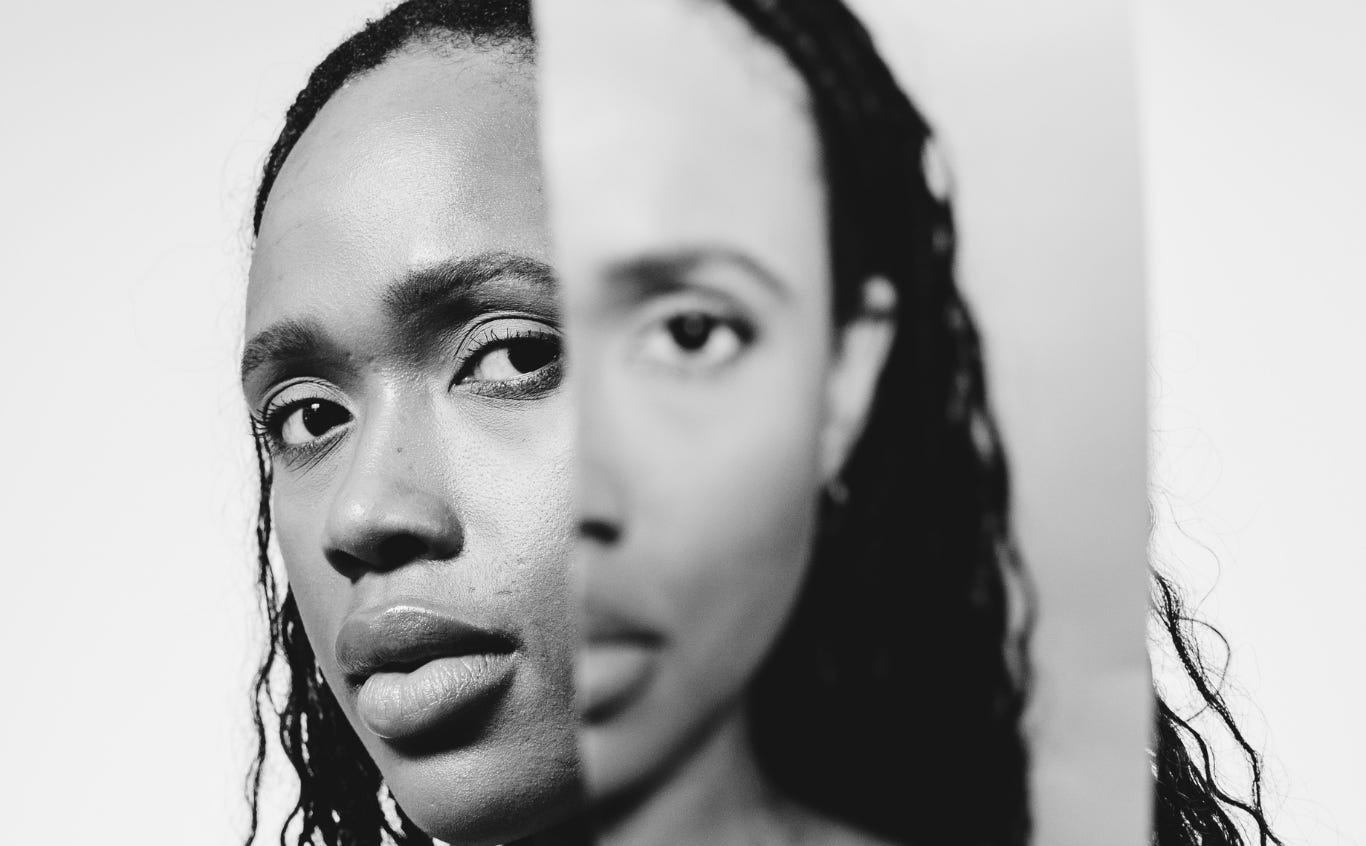
How do you know which version of you they’re looking at?
“Why the f*ck is it so hard to just be ourselves?” Well, one of the reasons is because people hold onto different versions of us. Sometimes those are old and outdated versions, like the parent who still treats their adult child like a teenager. And sometimes those are versions of us that never really existed, like the ex who insists that one day, you’ll become the person they always knew you could be.
How do you tell the friend who knows they can always count on you that they need to be more responsible and stop using you as their ride home?
How do you tell your boss who sees you as their go-to person that just because you worked overtime on the last two projects doesn’t mean that this is your new life?
Relationships can start to feel strained when the person you’re becoming no longer aligns with the person they thought you were. And, I hate to break it to you, but this goes both ways. We all have someone in our lives who we still see as the person they used to be.
What happens when we see things differently?
Personally, I struggle with being misunderstood. I try to be as articulate as I can so that my words and actions aren’t misconstrued. Which, let’s be honest, is a fairly lofty goal. Especially because, despite our best efforts, sometimes words come out wrong. Or people interpret them differently than we intended.
This Substack is my first creative project outside those sexy Excel spreadsheets (there’s a fun tongue twister). And, as I’m getting started, I’m asking my closest friends for feedback, and they’re giving me their honest opinions. But that doesn’t mean they necessarily agree with what I am trying to do. Frankly, I’m still figuring out what I’m trying to do! Which means that, sometimes, I’m stuck with the feeling of being misunderstood.
Cue a song that may stop a good number of you from reading or listening to the rest of this piece: “Stop Crying Your Heart Out” by Oasis.
The lyric, “take what you need, and be on your way,” has always had a special place in my heart. And, that’s exactly what I am learning to apply here. Accepting my friends’ feedback doesn’t mean that I need to surrender to it. I can take what’s useful and leave the rest. Maybe it’s not what I planned. Maybe I’m misunderstood. Maybe I just need to let go of these labels?
But what does it all mean?
Please strap in for a journey down the rabbit hole that is my need for perfect understanding.
My therapy fairy helped me find the words to describe what I am actually afraid of:
I am afraid that if someone misunderstands me, I will disappear. Who I actually am will cease to exist and I’ll have to live the rest of my life as their version of me.
I’m aware that’s some abstract shit.
So, here’s the grounded version: Thanks to how I was raised, I feel compelled to explain who I am. Otherwise I’m afraid that nobody will see the real me. Because, for a time, nobody did.
Yes, the way I describe my fear might sound odd, but the desire underneath it is something we all share. We don’t just want to be part of the group. We want to be seen and valued for who we are. Which can become tremendously difficult when the person we’re growing into no longer matches the person we were.
I built my identity around being someone who is so meticulous and precise that I could prevent others from misunderstanding me. The irony is that I ended up confining myself to what I defined as “a planner.” Now, trying something new that I can’t plan for isn’t just a fun little hobby. It’s a challenge to one of my core identities.
I don’t think the solution is to abandon one of my sharpest skills, but I probably need to stop defining myself by it.
So, what does “different” look like?
I don’t know if you’ve ever gone down a “but what’s the root fear underneath it all?” rabbit hole, but I’m sure you can agree that we all just want to be accepted for who we are. Not for who we were. Not for who someone wants us to be. And not as some outdated version of who we think we should be.
“Take what you need, and be on your way.”
Take what you need from the identity that once protected you. Take what you need from the person you used to be. Take what you need from those you have around you.
And let the rest go.
I wanna hold your hand.
Last song reference, I promise! This whole growth thing can feel uncomfortable, especially when we’re in the middle of it. I’m doing my best to hold my own hand as I discover new answers to that million-dollar question: “Who am I?” That doesn’t mean I don’t want someone else to hold it. It just means that whether I get support, or silence, or misunderstanding, I know I am going to be OK.
Aside from literally holding my own hand, I also like to give myself overly dramatic pep talks in the mirror (a real “coach” vibe) and end with an encouraging pat on the ass to get myself moving. It helps me feel like I am still here, even when I’m not meeting my 9/10 standard.
Notice I didn’t say “old” standard, because I can’t guarantee I won’t reach for reassurance through some of those ingrained self-contracts. In fact, I’m certain I will. But, each time I do, which hopefully is less and less often, I’ll be curious to see whether they still fit.
Let’s overthink this together:
Which parts of your identity still feel like you and which ones feel like old contracts you’re still living by?
If this resonated with you, drop your email below to get new explorations in your inbox every Sunday morning.
Subscribe to Sydney Buchanan for new explorations each Sunday.
I think who we are is something that is going to (and should) change through out our whole life. There is this weird idea that there is some end line when we should define our identities and just keep it forever. I refuse to do so. I want to evolve, I want to grow, I want to change my mind. Therefore any labels I'll come up with along the way, need to change together with me. And it is constant learning to be able to let them go, not to get too attached, for the reasons you describe. Putting yourself in a box, not matter how big, is always a constrain.
I think we get a little bit mixed up when it comes to identity. I think it might take a lifetime or defintely longer than up to 21 to even know our core identity.
We are born into a dynamic that we have no control over and it shapes who we are. Some of us think that is all there is and they live their lives that way, feeling dissonance and never knowing why.
I believe our identity doesn't start to take shape until we interrogate stuff, and experience stuff and not just by ourselves but with others.
So we can learn something from our parents, but it's not truly ours until we look at it, turn it around, wonder if this is me or them, what do I believe, what do others say about it, what do i think about what others think about it, etc. Then it starts to become more us but it doesn't end there because a person can never stand still in time. We have no choice but to move forward or back in relation to time. And so we grow or atrophy, and then we revisit whatever we initially learned from our parents and later interrogated, and then we interrogate it again, and a lot of times we update our beliefs about it.
I think that is what happens with identity in general. I am not who I was as a child, nor am I who I was at 16, 24, 36, or even 48, now that I am 49. Not even who I was yesterday. Because my experiences and the people I meet and interact with change me.
We are always changing, even if it is to just reinforce what we learned as children as we see the many different perspectives that interpret something.