


11 MIN READ · VOL. 01 · ISSUE 08 · PART I
As a recovering debate club enthusiast, and someone who revels in a little disagreement, I like to have a solid point and counterpoint on hand before sharing my opinion on a heated topic. So, naturally, I’m drawn to philosophies that demand adequate evidence before we accept something as truth.
Back in college, my philosophy professor introduced me to an essay that became the foundation for my personal doctrine of examined living. If you’ve read my work, you’ll know that I credit Socrates’ famous quote that “the unexamined life is not worth living” as the inspiration for my doctrine. But I owe my understanding of what it means to live an examined life to William K. Clifford (1845–1879).
His essay, “The Ethics of Belief,” argues that we have a responsibility to examine the evidence behind our beliefs before deciding they’re true. He took it a step further and asserted that, when acting on our beliefs, the outcome of our action is irrelevant and we should be judged solely on whether we had sufficient evidence to hold the belief in the first place. To put it in his exact words,
“It is wrong always, everywhere, and for anyone, to believe anything upon insufficient evidence.”
Now, you may be wondering why I’m bringing up a concept from an 1877 essay written by a man you’ve probably never heard of. So let me cut right to it:
I’m curious, how much do you really know about your beliefs?
Think about the beliefs you’ve inherited from your family, learned in school, from books, videos, or podcasts, maybe heard from your neighbor, a friend, or your partner. You may have formed a new belief today from something you saw on social media! But how much do you actually know about what you believe?
Now, this is not a philosophical publication, and I am not going to present you with an argument for or against Clifford’s theory. What I am going to do is walk you through “The Ethics of Belief” with a modern interpretation, so we can apply this ancient, 150-year-old wisdom to the digital age we live in.
I. The Duty of Inquiry*
Clifford’s essay starts with a story of a shipowner who, although he had some well-founded doubts about the seaworthiness of his ship, ultimately overcame his trepidations and sent the ship to sea with faith that the emigrants onboard would arrive at their destination.
The ship sank. The emigrants died. And he got the insurance money. Win/win, for him at least.
Easy question: Is he responsible for their deaths? Yes. More interesting question: Why is he responsible for their deaths? Simple. He should have known better.
The man accepted his own rationalizations and emotional reasoning as proof that the ship was safe to sail, to the point he believed it. And, rather than have the ship inspected, he quelled his doubts without any actual evidence.
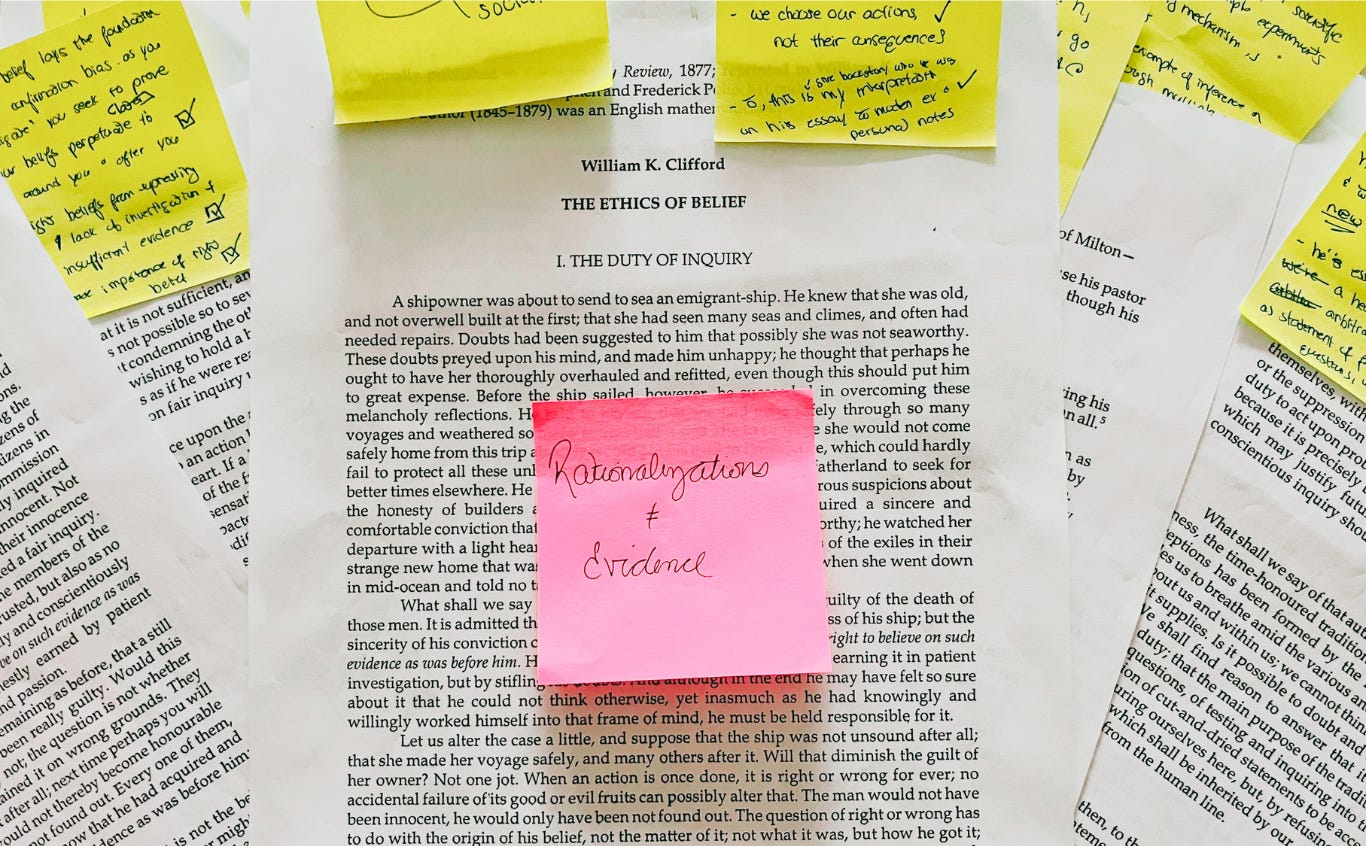
The outcome makes it easy to say he was guilty of the emigrants’ deaths. But the outcome itself is not what makes him guilty. The fact that his beliefs and consequent actions were based on his feelings, rather than any actual evidence, was where he went wrong. The ship could’ve arrived safely and he would still be wrong, just not publicly.
In millennial terms:
We choose our actions, not their consequences.
Emotions and rationalizations aren’t evidence.
Being lucky about the outcome doesn’t mean that we were right. It means we were lucky.
How many times have you talked yourself down by saying things like “I’m overthinking it,” “it’ll all work out in the end,” or “it turned out alright! Nothing to worry about?”
I’m not saying that self-soothing through reassurance is evil. I do it fairly often! But convincing ourselves to believe something based on absolutely zero evidence isn’t a great way to approach our core belief systems.
Clifford goes on to introduce another example of an island community that believed children were being indoctrinated into a religion by questionable means. A group formed to protect the children and began making very public accusations against certain community members.
Eventually, a formal commission was formed to investigate, and can you guess what they found? Absolutely no evidence to support the claims being made. In fact, there was ample evidence that showed the accused were innocent, and it wasn’t that hard to find. It was obvious the accusers hadn’t done their homework before making public statements.
This poses the same question as before, but in a slightly different manner.
Were the men who formed the group responsible for their actions and the resulting embarrassment? Yes. Why were they responsible? Because, despite being rallied into a group consensus by high emotions and personal bias, they should have known better.
I would be remiss to not draw a connection between emotionally passionate claims and politics. The same patterns show up each time a political issue becomes a point of contention:
A political opinion becomes conflated with a moral high ground (this is good, that is bad).
People group together based on their political opinion.
Some accept the claim because it supports what their side already believes, and others reject the claim because accepting it would mean betraying their group.
We’d benefit from spending less time feeding into emotionally and morally driven political statements and more time genuinely investigating the evidence behind the claims.
Now, Clifford does acknowledge the difference between having a belief and acting on it. You can’t be arrested for having a bad thought (we’re gonna stay clear of that conversation), but you can and should be held accountable for your actions.
But, let’s say I ask someone who is vehemently opposed to a political opinion to review objective evidence that supports that opinion. What are the odds their belief isn’t going to impact their conclusions? Probably zero. Realistically, our beliefs are the driving force behind our actions, which means we can’t sever them completely.
Let’s pivot to the very modern phenomenon of social media.
With Instagram, you’re often exposed to new beliefs within the first 3 seconds of a video. It’s quite literally designed to feed you content that hooks your attention so you stay engaged with the app.
Think of its therapy-adjacent videos. You may feel like you learned something (and maybe you did), but that could be because it’s designed to make you feel something. In this case, to feel instantly validated by a stranger, to the point you’re pulled into their beliefs and want to like, follow, and share their content without ever asking a single question.
The trending “bitch era” videos are the embodiment of half-baked advice being perpetuated en masse. If someone is unable to set and hold healthy boundaries, the solution is not for them to be a total bitch because they’ve “tried the nice way.” They may need to work on their boundaries, emotional regulation, stress tolerance, communication, or find a way to end whatever relationship the pattern keeps repeating in. Either way, the solution is not to treat people in ways you would not want to be treated, while calling it personal growth.
Alas, here we are. So, if you find yourself justifying behaviors that you know you wouldn’t want done to you, consider that a red flag to evaluate the beliefs you’re acting from.
Now, I’ve made Instagram clips, and I’ve decided to pivot to long-form YouTube videos so I have more room to explore complex ideas. This is not a shot at Instagram’s framework or the content that’s on there. My point is that when you try to compress complex ideas into bite-size chunks, you risk losing the foundational knowledge that’s required to form a belief based on evidence, not emotion.
And I’m not immune to this! I’ve watched at least a dozen videos that prove my ex is a narcissist. Of course I have no idea how to diagnose a narcissist and have serious doubts the guy on Instagram knows my ex, but I do know that belief helped me heal from our breakup.
I’m not criticizing anyone for doing this. I’m just highlighting how much we do it, and how often it goes unchecked.
My first essay, “We Explain Before We Experience,” touches on why we cling to explanations and mistake understanding for acceptance. In short, explanations can kill curiosity, given that we don’t usually question what we already understand. I want to connect the dots here by noting that, in this context, believing something can feel like understanding it, which creates a sense of control.
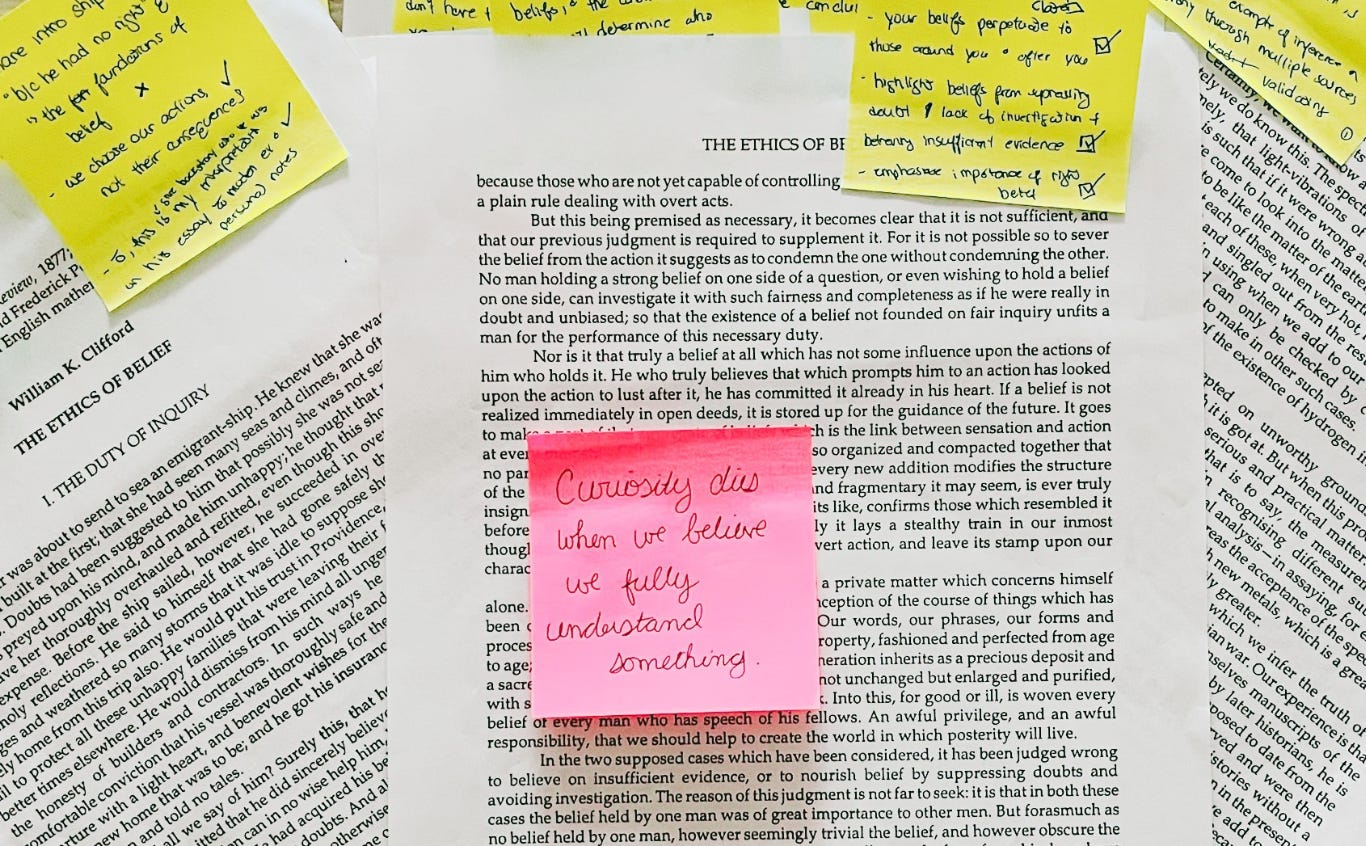
Now, why would anyone risk losing control by asking questions and evaluating evidence in a way that betrays their beliefs? Unless you’re aware of your inclinations and actively keeping them at bay, it’s likely you’ll fall into some sort of confirmation bias when you investigate an opposing idea.
Going back to Instagram, if you find one video, then another, then another, that all say the same thing, where do you draw the line between learning something new and merely reinforcing what you already believe? And, just curious, how many of your new beliefs do you start preaching as fact?
The same echo chamber happens when you give AI a biased prompt. Load a question with assumptions and a predefined conclusion, and you’ll get an answer that aligns with whatever you already believe. AI’s response may sound true, but that doesn’t make it true, which is probably why the systems have so many disclaimers!
To be clear, having what we’ll call a “right” belief, a belief based on sufficient evidence, could still lead you to make the wrong decision. But at least it was founded in evidence. And, from Clifford’s perspective, that makes all the difference in whether or not someone had the right to hold that belief.
Now, I’m going to confess something I did based on what I think was a right belief, but was counter to widespread public opinion.
During COVID, my province was locked down by health zones and only essential travel was permitted. So, when my great-uncle told me he’d applied for MAID (medical assistance in dying) and planned a very small get-together to say goodbye, I really didn’t know what to do. “Essential travel” is subjective, and that made it hard to feel confident whether my government would agree this was essential. A lot of people lost family members during COVID and they weren’t able to say goodbye. But we found ourselves in a very unique scenario where my great-uncle was in control of the time and place.
This was the last time I would get to see the man whose artwork and furniture now decorate my home. He meant a lot to me. I wasn’t going to say “yes” based solely on emotion, but I also wasn’t going to say “no” based on someone else’s opinion.
So, like the data nerd I am, I went to my province’s COVID dashboard, where they published live updates and, shockingly, gave access to the raw data. I pulled the raw data. I analyzed it. I even had my then-boyfriend vet the logic and formulas I’d used to make sure I wasn’t omitting an important consideration.
Without getting into the details, I’ll just tell you that the data we saw showed a very different picture than what was being broadcast. Our risk and the risk to others at the gathering, given the precautions we would take to isolate during and after, were well within our tolerance. We visited my great-uncle and got to say goodbye.
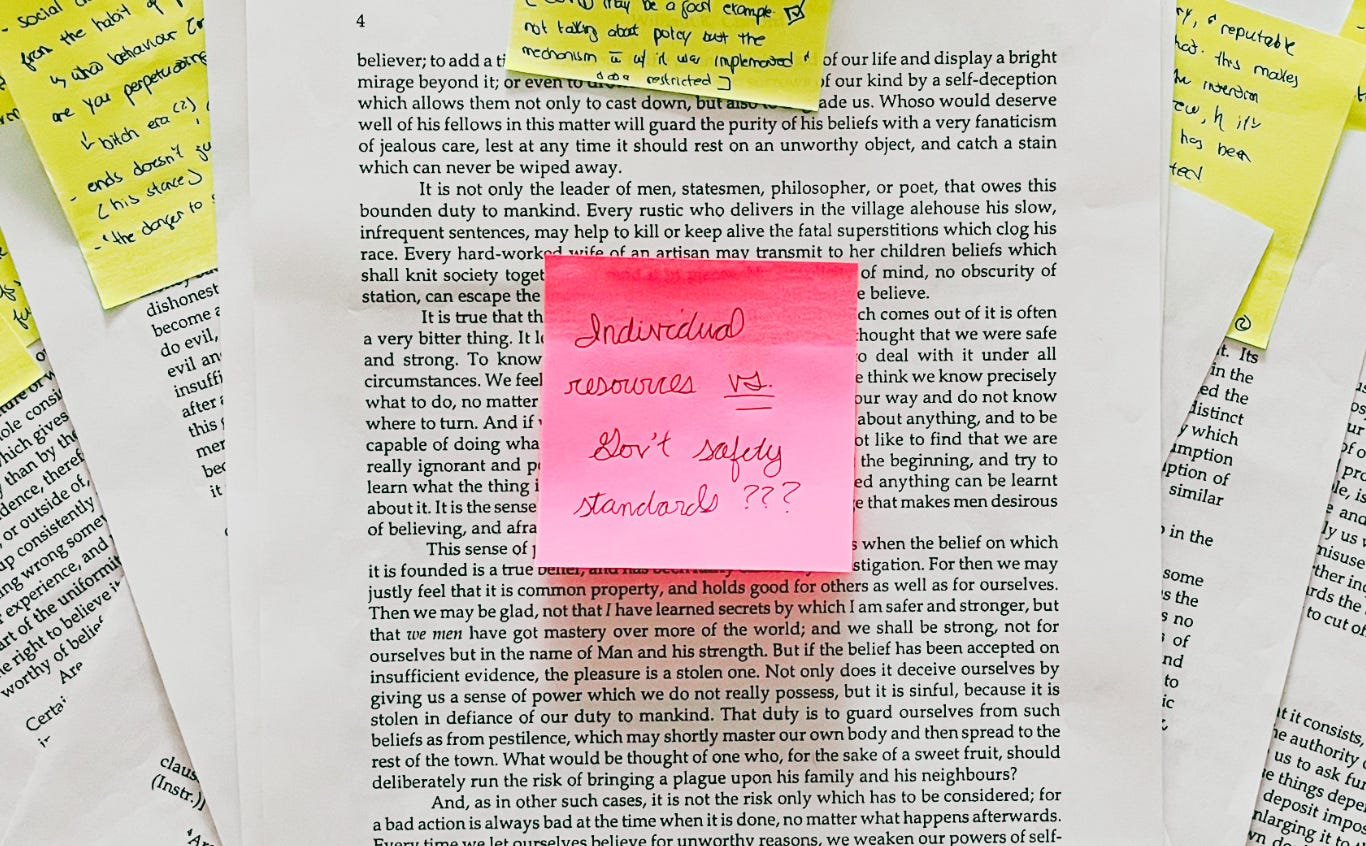
This isn’t a stance on COVID measures or a declaration of what’s right or wrong. I had the privilege of gathering information from a reputable source. However, the analysis displayed on the dashboard and the numbers being circulated by the news didn’t include the information I found when I analyzed the raw data. The information I gathered was widely available, just not widely advertised.
So, was my belief that I could visit my great-uncle “right,” in the sense that it was based on what I considered sufficient evidence? Yes. Was my government’s belief that I should have stayed in my health zone “right,” in the sense that it was based on what they considered sufficient evidence? Yes. My personal interests as part of a two-person household, with full knowledge of our health and resources, led me to prioritize different data than my government, which had to account for the health and safety of millions.
But whose standards are actually right?
… I don’t have an answer for that one.
*Section heading from William K. Clifford’s “The Ethics of Belief” (1877).
That’s a wrap for Part I.
Part II will explore how “The Weight of Authority” and “The Limits of Inference” (Clifford’s words) collide with the digital age, including our responsibility for the (mis)information we spread, how to know who we can trust, and what to do when we don’t have any evidence.
Let’s overthink this together.
Take a minute and think about a newly formed belief. It could be something you picked up from a newsfeed, a conversation, or your own internal monologue.
Got it? Keep it in mind as you work through these prompts:
How did it become a belief? Be specific: when did you decide it was true, what was that decision based on, and why did you decide that evidence was sufficient?
What does the belief do for you? Look at what the belief gives you. Maybe it offers a sense of control, an excuse, or some relief. What would happen if you had to let it go?
Is there another way to look at it? Play devil’s advocate and look for evidence that challenges your belief. What would make you trust it a little less? Had you thought about that before?
What’s the cost if it turns out to be wrong? We choose our actions, not their consequences. What happens if it turns out your belief was wrong? Is there anything you’d do differently?