


07 MIN READ · VOL. 01 · ISSUE 09 · PART II
This is Part II of a multi-part series. If you haven’t already read “Is a personal rebrand the new mid-life crisis?” I suggest you start there.
According to my Webster’s Ninth New Collegiate Dictionary, a book that’s older than I am, a belief is defined as a “conviction of the truth of some statement or the reality of some being or phenomenon esp. when based on examination of evidence.”
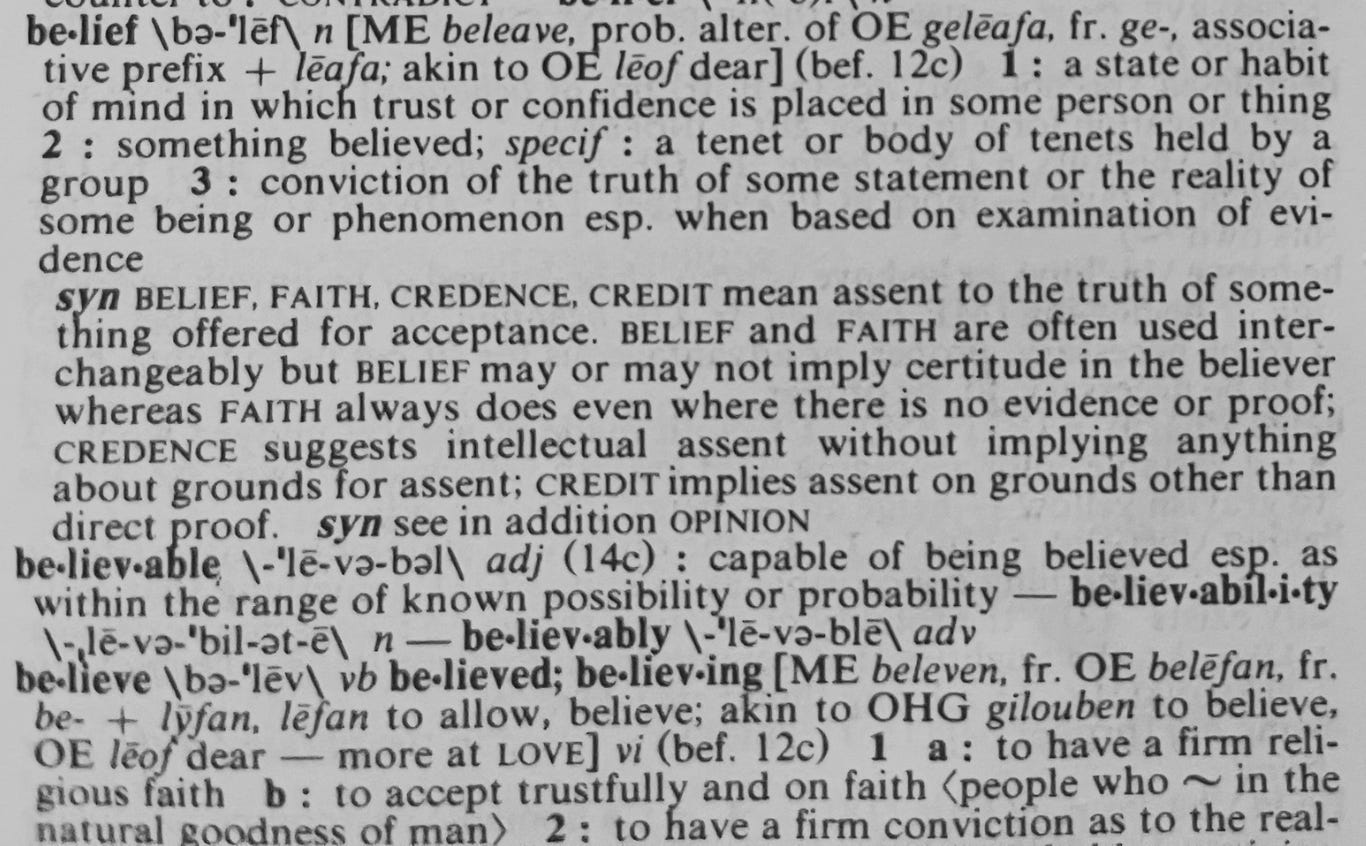
While I love a good definition, we can simplify this tremendously by saying a belief is just a thought we accept as truth. Unlike the many fleeting thoughts we have throughout the day, a belief is something that we anchor to, even something we identify with. And a belief’s value isn’t solely based on whether or not it’s true. Sometimes it doesn’t matter if your belief is true. What matters is that you believe it.
Essentially, a belief is a filter. It determines how we interpret and experience reality, not what is actually happening. You know that saying, the one about wearing rose-colored glasses? Well, this is what it’s referring to. When you look at the world through rose-colored glasses you become overly optimistic and idealistic, often ignoring or altogether missing the potential negatives or risks in front of you. If you’re wearing rose-colored glasses, you’re not seeing the whole picture. You’re seeing what you want to see. What you want to believe.
This is where we arrive at the intersection between what is real and what we believe is real.
Because both have tremendous power over our lives.
I’m curious, what stories do you tell yourself?
Maybe you rehash what went wrong in your last argument with your partner, a family member, or coworker. “Everything would’ve been different if they’d just done what I told them to do! They never listen.”
Do you find you need to justify certain behaviors? “I can’t help it if they were offended. I’m blunt and some people just don’t know how to handle that.”
Perhaps you think others should be treating you differently. “I just wish they’d text me more often. I always have to reach out first.”
I’m particularly interested in the thoughts you repeat; those can be sneaky ways that beliefs disguise themselves as facts.
If we examine our stories, we may notice that, regardless of what is objectively true, the conclusions we draw can end up having more of an impact than the truth itself.
“Everything would’ve been different if they’d just done what I told them to do! They never listen.” Let’s give the full benefit of the doubt and assume that, had this person done as they were told, things would have been different. So, the truth may be that they didn’t do what we asked, but the belief we’re reinforcing is that we’re right and they never listen.
“I can’t help it if they were offended. I’m blunt and some people just don’t know how to handle that.” Again, let’s give the full benefit of the doubt and assume that this person cannot handle someone delivering blunt truth to them (this also assumes what we’re saying is true). The truth may be that we’re blunt and they have trouble metabolizing blunt statements, but the belief we’re reinforcing is that we can continue to behave however we want and the other person needs to deal with it.
“I just wish they’d text me more often. I always have to reach out first.” Talking in absolutes (always, never, all, none, etc.) is an immediate signal to separate what’s objectively true from our assumptions. It may be true that they don’t text first, but the belief that we’re reinforcing is that the relationship will fall apart if we don’t manage it.
Part of what spurred last week’s essay, and this entire series, was a call I’d had with another friend...
I shared that I’d hit a melting point with the negative thoughts in my head. I knew they weren’t the whole truth, but they would not stop. I’d tried meditating, rationalizing, and self-soothing, but nothing was working. So, I tried something new.
I pulled out my laptop and typed out every single negative thought. Completely freeform. No edits and no reservations. Then, before I could start rationalizing, I grabbed a big piece of poster board along with a permanent marker and proceeded to first smell the marker (who doesn’t love that smell?), then reframe every single negative thought.
While I am proud to say that I deleted the doc immediately after (part of banishing the negative thoughts), it would’ve been helpful if I’d kept it for this article. A couple of examples that stuck with me were:
“I don’t know what I’m doing” became “I am a great learner. I pick up things quickly.”
“Things never work the way I want them to” became “I am not afraid to try again.”
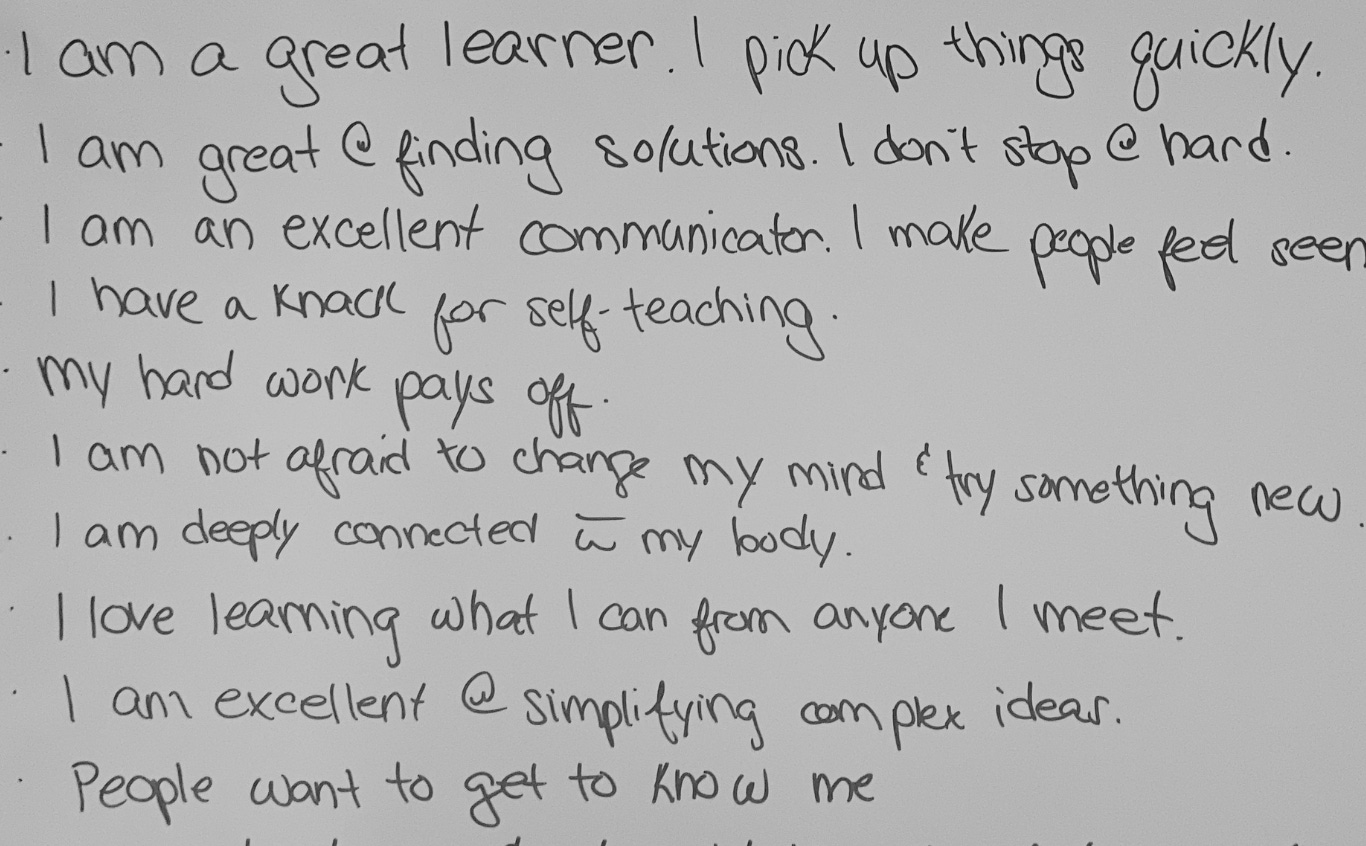
The purpose of the reframe wasn’t to put a positive spin on things or trick myself into thinking something wasn’t true. Rather, it helped me to explore the emotion beneath each thought so I could address it head-on.
Sure, there are genuinely times when I have no idea what I am doing. But, rather than dwell in that thought and feel helpless, I can reframe it by reminding myself that I am, in fact, a very fast learner. So, if I don’t know, I can learn.
I keep the poster board beside my desk so it’s at hand whenever my mind starts to wander. I read it top to bottom every time a (unhumorously) self-deprecating thought pops in my head. I read it when self-doubt starts to creep in. And I read it whenever I need to remind myself that I am doing my best and deserve to celebrate it.
Now, it wasn’t a scientific experiment, but the results have been stellar. Those negative thoughts rarely make an appearance, and I’ve become incredibly intentional about meeting my doubts with a dose of reality.
How does all of this tie back to living a life that’s in alignment with our passions, who we are, and who we want to be?
Well, first we need to make sure we’re not sabotaging ourselves by building our plans on beliefs that hold us back from seeing things for what they are. So, let’s start with our beliefs.
Let’s overthink this together.
Last week, you named a self-limiting belief you wanted to tackle. Now it’s time to explore how that belief shows up in your everyday thoughts.
Is there one thought in particular that keeps reinforcing your belief? How could you reframe it?
Separate what you know to be true from what you’re assuming. Look for the emotion beneath the belief and think about how you’ve soothed that emotion in other contexts.
The reframe should feel like a new belief. Not just a positive spin on how you’re feeling. Stuck? DM or email me. We can chat through things together.
Binge-worthy content.
Encore for Programmed to Fail, Brandon Epstein. This book helped me see (quite literally through the exercises and journaling prompts) the connection between my thoughts, emotions, physical sensations, and actions. Brandon taught me how to reframe, and it’s changed my life.
Neuroscientist breaks down 3 bizarre mind-body phenomena — and their medical impact, Big Think. I was fascinated by how David Linden explained the mind/body connection from a biological perspective. He breaks down the interconnectedness of internal and external senses, including how the body sends information to the brain and the interplay of physical and mental states. As indicated by the title, he beautifully illustrates the role of belief in our health and overall wellbeing.
We have more to fear from stupid people than evil ones, Big Think. I love everything about this video (bonus points if you can guess why). In particular, Jonny Thomson provides a simple and direct explanation for Dietrich Bonhoeffer’s argument that stupidity is more detrimental to society than evil (Bonhoeffer has a precise definition for stupidity) and wraps up by sharing René Descartes’ famous thought experiment of radical doubt. Thomson has a knack for presenting complex philosophical concepts in very simple terms.
I’m experiencing my own levelling up right now and this is 100% true!
Markers smell good.
Meant to ask on your last post about the koala bear comment. Was there context for that or was it intended to be totally random so it receive attention? You could be on to something there.
Love the type out all bad thoughts part and then inverting.
Keep going.