


10 MIN READ · VOL. 01 · ISSUE 08 · PART II
We covered a lot of ground in “You probably have no idea what you’re talking about,” so let’s start with a quick recap before we continue our journey through William K. Clifford’s “The Ethics of Belief.”
In a nutshell, Clifford asserts that it’s imperative to scrutinize the evidence behind our beliefs.
He explains that, even when false beliefs lead to favorable outcomes, we still have a duty to examine whether or not we had a right to hold those beliefs in the first place.
We touched on how points of view are often perpetuated without question through social media and the dangers of forming beliefs based solely on emotion.
We also defined a “right” belief as being based on sufficient evidence, while acknowledging that a right belief isn’t necessarily infallible (it can still turn out to be wrong).
Ultimately, we’re responsible for what we perpetuate.
So, shouldn’t we apply some due diligence before we ask our community to accept our beliefs as facts? Or perhaps we should start by acknowledging how much our communities are defined by our belief systems?
The people you surround yourself with, the types of ideas you’re open to hearing, and the amount of pushback you’re willing to tolerate are all based on your own morals and belief systems. You may think that you’re part of an open-minded and accepting community, but it could just be that you all agree on what it means to be open-minded and accepting.
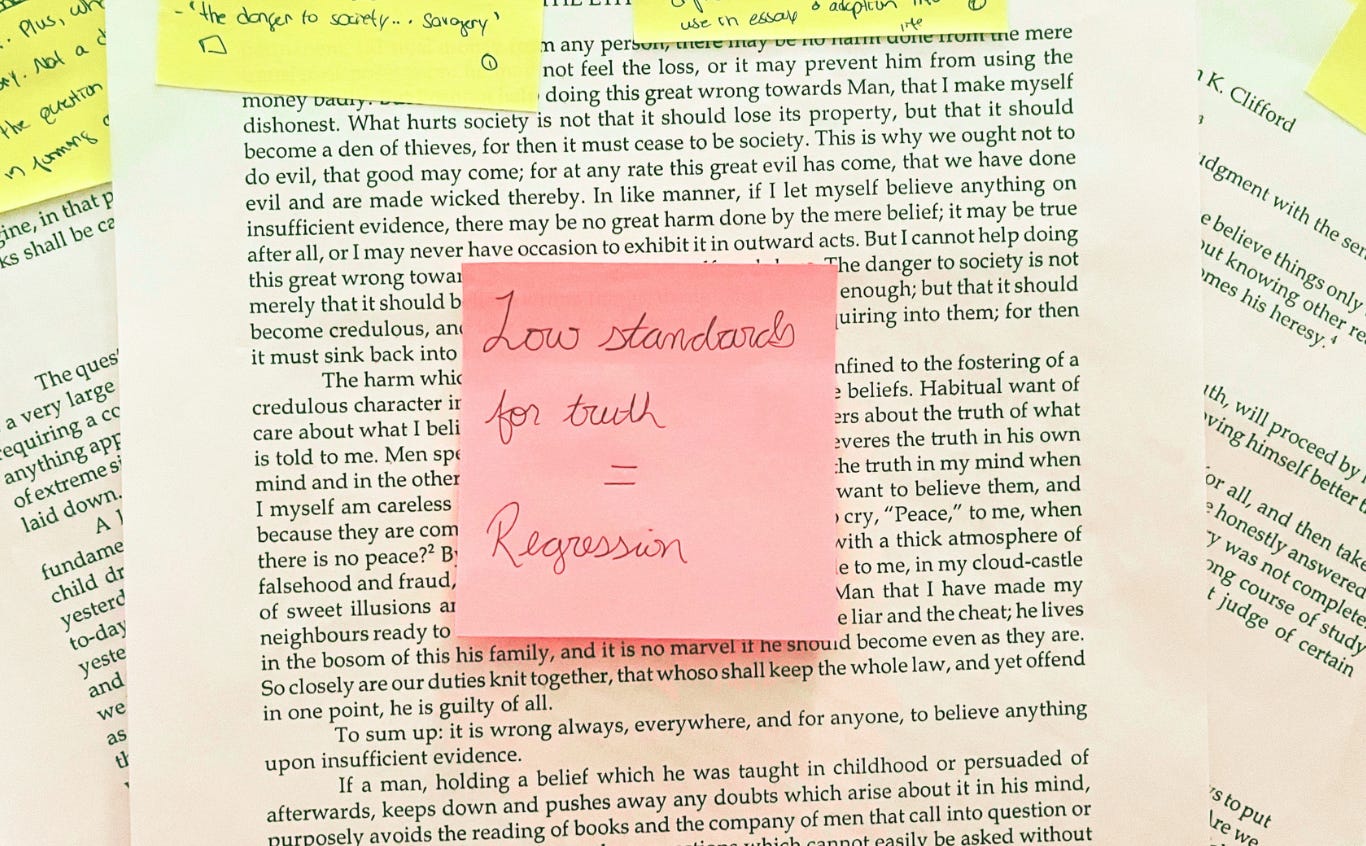
The degree to which you pressure test your beliefs, rather than accepting them at face value, doesn’t just affect you. It affects everyone around you. Namely, your closest family and friends. To quote Clifford, “The danger to society is not merely that it should believe wrong things, though that is great enough: but that it should become credulous, and lose the habit of testing things and inquiring into them, for then it must sink back into savagery.”
Another millennial translation:
If you accept beliefs without questioning them, you’re an easy mark for anyone who wants to influence your opinion.
Consequently, if you’re part of a community (family, friend group, political group, etc.) that follows what they’re told, without question, you’re complicit in lowering the level of scrutiny and standards for something to be called “truth.”
Low standards for truth paired with a lack of critical thinking is regression, even if it’s sold as unity.
I’ll admit that our core belief systems are formed long before we have the words to articulate them. But it seems fair to say that anyone reading this essay is capable of finding information that could challenge even their longest-held beliefs.
“That’s just how I was raised,” and “I don’t have time to look into it” aren’t valid reasons to perpetuate uninformed opinions when you have the means and privilege to do otherwise. I’m paraphrasing here, but Clifford offers simple terms that if you don’t have time to investigate a belief, you shouldn’t have time to believe it either.
This level of discernment is one of the biggest gaps in our political conversations. I mentioned in Part I that “we’d benefit from spending less time feeding into emotionally and morally driven political statements and more time genuinely investigating the evidence behind the claims.”
I’ll add to that now by giving some completely unsolicited advice: My personal litmus test for whether I want to engage in a political conversation with someone. It’s easy! I just ask whoever is making the argument to give two valid counterpoints to their opinion.
If they can’t, that’s my signal that they haven’t done what I’d consider due diligence in investigating the claims they’re spreading. At that point, I’m not interested in being part of the conversation. Not because I don’t think they have something valuable to say, but because I can’t trust their interpretation. And, in that case, I’d rather research the subject myself, with a fresh perspective, than start off with a potentially biased point of view.
II. The Weight of Authority*
We need to be practical about how much due diligence we expect someone to perform before sharing their beliefs. Partly because experts have probably already looked into it, but also given that our evolution is based on the wisdom we pass from generation to generation. The purpose of forming a right belief isn’t to question everything for the sake of it. It’s to ensure that the evidence we’re basing our beliefs on still holds up to present standards.
Clifford notes that humanity has already done its duty in testing what have become the foundational principles we live by, including basic moral standards and laws of nature. If these beliefs are subject to further testing, the evidence will either continue to prove what we already know to be true, or lead us to more interesting discoveries.
This saves us from having to test everything from scratch and enables us to continue to expand our foundational knowledge. We can trust past generations’ conclusions and still remain open to discovering new questions and methods to test what we already believe.
On a scientific level, quantum physics was born out of classical physics’ inability to explain the behavior of an atom at a microscopic level. We didn’t stop asking questions because our present model failed to answer them. We expanded our understanding of the problem to be solved, and in turn found an entirely new solution.
On a social level, we continue to develop policies to ensure we’re supporting the needs of our citizens, while simultaneously questioning the basis for policies in development. What can present as a chaotic political system is also our way of ensuring we’re demanding sufficient evidence when making sweeping changes.
Now, I’d like to share an unintentionally meta example of trusting a source’s authority. I’m basing this essay on a printout my college professor gave me back in 2015. I kept it because it meant that much to me. But, as I was reviewing it to write this essay, I noticed this particular section is actually an abridged version of Clifford’s original!
So, in truth, I’m not basing my conclusions on the entirety of Clifford’s words; I don’t know them. I’m basing them on the trust that my college professor didn’t omit paragraphs that would completely invalidate the beliefs I’ve formed.
I hope you appreciate the irony as much as I do. And, if you have questions on the missing sections, let me tell you right now that “I don’t know,” but I’ve ordered a full version of the essay so I can find out for both of us. In the meantime, my essay deadline is sooner than Amazon’s delivery schedule, so I’ll count this as evidence that I’ll survive publishing something that is less than perfect.

III. The Limits of Inference*
So, if a right belief requires evidence to support it, what happens when we can’t validate a belief with direct evidence or experience? To answer this, Clifford argues that:
Nothing but the present moment can be validated by direct experience.
Our beliefs are founded on the assumption that the future is consistent with the past.
The past isn’t really direct experience. It’s a memory that’s prone to mistakes.
Confused?
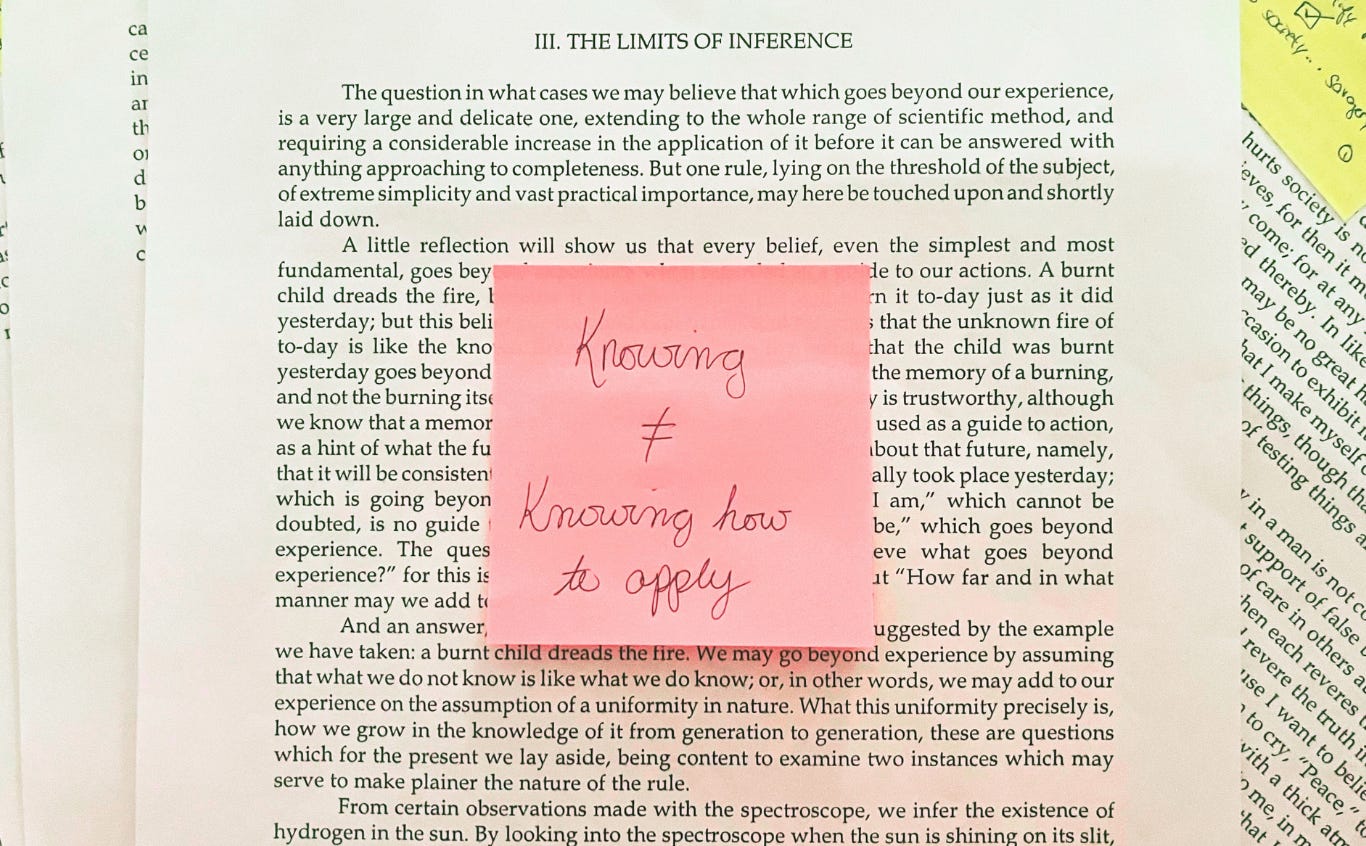
To put it in simple terms, we can only experience the present moment. The past is a memory, and the future is merely a prediction that assumes some level of natural uniformity. And, while we can acknowledge that nature isn’t always uniform (modern science continues to challenge what we believed was possible), it’s really the best working assumption we have for things we can’t test.
To help illustrate this, Clifford gives examples that involve a spectroscope, the sun’s hydrogen, the Peloponnesian war, and potential forgeries. Not nearly as emotionally evocative as the shipowner and island community from Part I! Rather than dive into the particulars of his examples, I’ll give you a quick summary so we can explore how to apply Clifford’s rules of inference to everyday life.
In keeping with the rules of uniformity, Clifford highlights that with available evidence (how hydrogen behaves on Earth) and proper testing mechanisms (the spectroscope), we can draw conclusions about things we haven’t directly tested by comparing them with things we have (in this case, identifying hydrogen in the sun the same way we do on Earth).
For a modern translation, let’s go back to Instagram’s therapy tips. Some observations are rooted in genuine advice from professionals while others are rooted in AI scripts that were never subjected to scrutiny. Without reliable sources (authority), it’s tough to know if the information you’re getting is accurate, never mind whether it applies to your personal circumstances (inference).
Alright, so what point was Clifford trying to make about how an ancient war and potentially forged documents can help us define how we draw conclusions? In short, a single document (a manuscript) may not provide conclusive evidence of an event (the siege of Syracuse during the Peloponnesian war). But, if its story can be corroborated by other documents from credible sources (like additional manuscripts and books), we can use the rules of uniformity to draw a reasonable conclusion about what likely happened.
On the flip side, if a document appears to be tampered with or comes from a disreputable source, we can’t confidently draw conclusions from it without further evidence.
How does this translate to us? Look no further than whatever device you’re using to read this essay. We’re inundated with advertisements claiming that a product is the #1 recommended [insert product type here] by the top [insert profession here]. But, if you look at the fine print at the bottom of the screen, which nobody does, you’ll see a number of disclaimers and qualifiers that narrow what the claim actually means. Aside from hiding figures in the fine print, ads can also use loosely defined terms or statements that may be superficially true, like calling products non-toxic, cruelty-free, or ethically sourced, without sharing the actual data used to support their claims.
So, what now? Am I suggesting that you abandon your beliefs, subject all new information to thorough examination, and monitor your friends and family to ensure they only perpetuate ideas they can prove with evidence or direct experience?
I’d love to say “yes,” and that this is the abridged version of my essay.
But no. Realistically, you can’t question everything about everything. Analysis paralysis is real and we need to make reasonable assumptions in order to live in modern society. Not only is it okay to make a decision based on a belief that you’re not certain of (“I don’t know” but I’m going to do it anyway), you also don’t have to follow Clifford’s words to a tee.
The purpose of these essays is to give you a modern take on “The Ethics of Belief,” not to argue for or against Clifford’s claims. If you’re interested in another way to look at things, William James’ “The Will to Believe” offers a direct critique of Clifford’s claims and may very well address any reservations you have in accepting his argument.
You don’t need to have an answer for everything. But there is a significant gap between admitting you don’t know something and are choosing to believe it anyway, and insisting that your beliefs are facts while refusing to question them.
*Section headings from William K. Clifford’s “The Ethics of Belief” (1877).
Let’s overthink this together.
Think of an opinion you’ve recently accepted as truth. Maybe it’s advice from a friend or something you’ve heard so often you’ve stopped questioning it.
Got it? Keep it in mind as you work through these prompts:
Why do you trust this source? Where do they get their authority from? Are they an expert, is this from first-hand experience, or do you just agree with what they’ve said?
What does the evidence say? Does the evidence support your assumptions or is there something you might be stretching to fit your beliefs?
What’s missing? What don’t you know about the opinion, source, evidence, or limits of understanding? Does acknowledging this gap change how you interpret the opinion?
Is it compatible with your other beliefs? How does this new opinion stack up with your current belief system? Be critical of how it challenges or supports what you already accept as truth.