


06 MIN READ · VOL. 01 · ISSUE 09 · PART IV
Welcome to Part IV of our [WORKING TITLE] series, where we’re exploring how to create a life that serves you. If you’re new here, “Is a personal rebrand the new mid-life crisis?” was the question that spurred this conversation. Feel free to start at the beginning or join us as we dive into the next step in our DIY framework.

You know that nagging feeling that something isn’t quite right? Maybe something you said or did just isn’t sitting well. Or perhaps someone’s relatively benign comment spurred a BIG emotional reaction in you.
That type of internal friction is a telltale sign that something, or someone, is pushing up against your personal values.
The simplest way to think of personal values is as a moral compass. You can use them to navigate between appropriate behaviors and those you want to steer clear of. They can also determine how you show up in the present and help you plan for the future.
Without values to anchor you, you might find yourself making decisions based on impulse, emotion, convenience, (cold hard) logic, or whether or not Mercury is in retrograde.
Sometimes we knowingly act in a way that betrays our values. For example, if you value kindness and treat someone with cruelty, no amount of mental gymnastics or justifications will let you off the hook for betraying your moral standards.
Other times we may be entirely unaware of our values, and consequently feel stuck in a state of disharmony we can’t quite explain.
I spent about two and a half years living in that state of disharmony during my last relationship.
The feeling wasn’t foreign to me. In fact, it felt just like my childhood. I recognized the volatility, and I thought I’d grown up enough that I could handle it differently.
I came to realize, through 8 weeks of group cognitive behavioral therapy (CBT) followed by another 12 weeks of group dialectical behavioral therapy (DBT), that it was never a matter of growing up. I needed to step back from chaos, see the forest for the trees, and start making different choices.
So, I chose to carve a life around my values instead of my emotions. Regardless of how BIG and valid my feelings were, I needed them to come second. I was committed to doing what was best for me, even if it didn’t feel good in the moment.
Unbeknownst to me, I had been living in contradiction with some of my most deeply held values. And that contradiction was painful. I wanted someone to love me so badly that I didn’t question whether the way they were treating me was actually loving. The emotional void in my chest so craved a sense of connection that I let it define what I deserved.
I know she wasn’t singing about romantic love, but I used to replay Santigold’s “L.E.S. Artistes” when I was in doubt. I would repeat the lyric:
“I can say I hope it will be worth what I give up.”
I had decided that being loved meant I had to give up the pieces of myself I was told were unlovable. And I hoped that, in the end, it would be worth it.
It wasn’t.
And once I could see the tension between how I was acting and what I valued, my emotional floodgates opened in all the best ways.
My internal monologue shifted from “there’s something wrong with me” to “I can do things differently.” Shame transformed into compassion, and expectation gave way to grace.
Defining my values even opened the door to challenging one of my longest-held beliefs: “I will always be alone.”
So, let’s create a baseline for the life that you want.
Easy question: What would “a life that serves you” look like?
More interesting question: Who do you want to be?
Let’s overthink this together.
By this point, you’ve identified a self-limiting belief and explored how it shows up in your everyday life. Now, let’s see how that belief knocks up against your values.
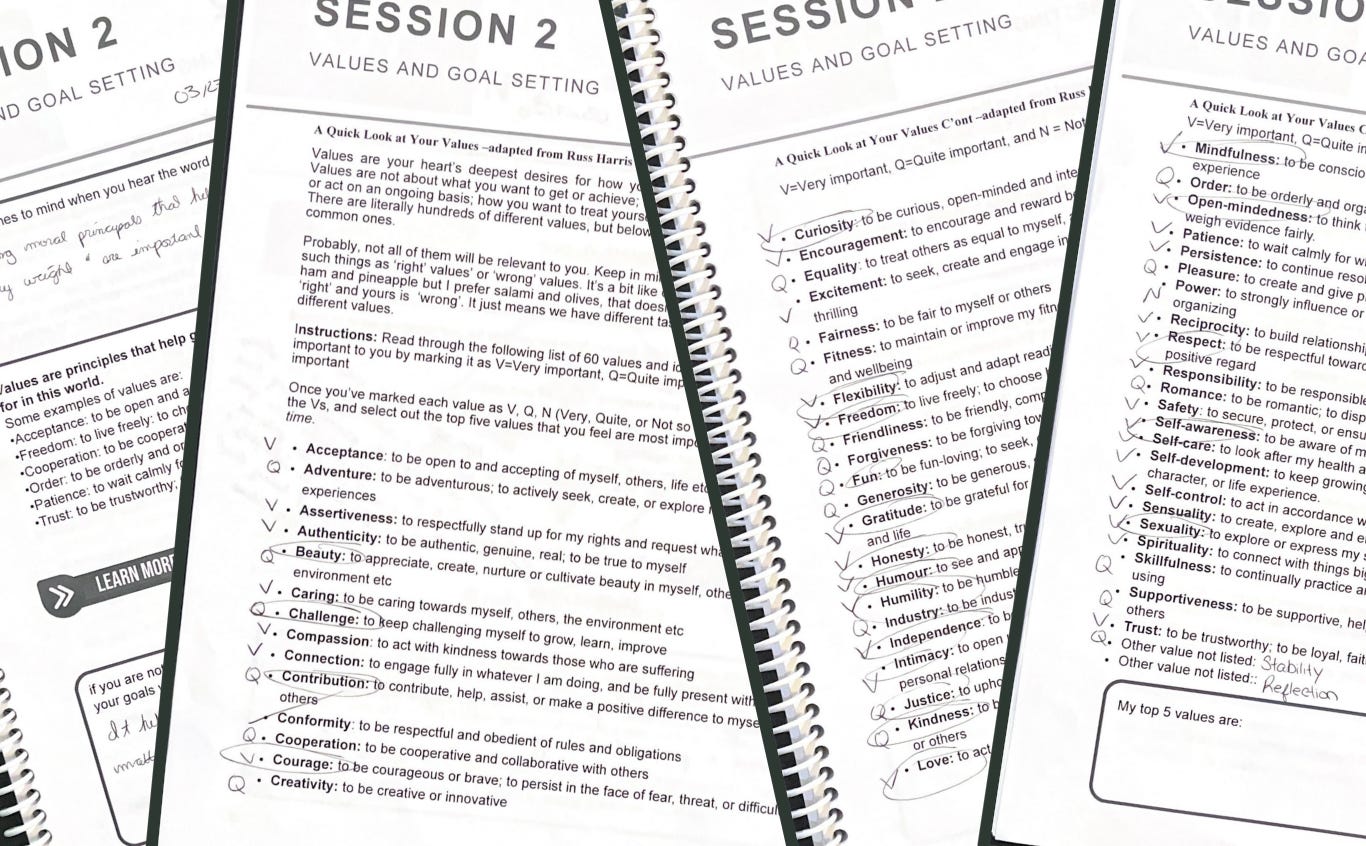
Start by making a list of 3-5 values that are connected to your belief. If you want a shortcut, take a peek at Dr. Russ Harris’s “A Quick Look at Your Values” and see which ones resonate with you.
Once you’ve got your values, use the questions below to explore how they influence your belief. If you need some inspiration, skip to the end of this essay and take a look at my answers. You’ll notice that I didn’t answer every question outright, and you don’t have to either. Take what you need and leave the rest behind (cue Oasis).
Where does your belief overlap with your values?
What are the gaps or areas of tension?
What thoughts and feelings come up when you compare your belief to your values?
Is there an underlying theme or thread that connects your belief to your values?
Once you’ve done some digging, prioritize 1-3 values you’d like to be more intentional about as we continue this series.
Me overthinking out loud.
My belief that I will always be alone sits comfortably between my values of independence, intimacy, and love:
Independence fuels my immediate defensive reaction that I’ve survived on my own and can survive on my own. Not to say that I want to. But I can! Also, complete side note, but I JUST realized why I love Gloria Gaynor’s “I Will Survive” so much! The subconscious mind is a funny thing.
Intimacy is a double-edged sword. I crave the intimacy of a close relationship, but I also fear what that intimacy can demand. What happens to my independence? What if they don’t like what they see? What if it’s not worth what I give up…
Love is the sharpest edge of them all because, to be frank, I’ve had a fairly fucked up definition of it. My parents taught me that love came with abuse and abandonment. Loving my son meant placing him with another family who could give him what my love couldn’t. I didn’t even believe in unconditional love until I divorced my now ex-husband. And being loved by my ex-boyfriend involved reliving my deepest childhood fears with a grown man in place of my mother (props to Freud).
I notice an underlying fear of being vulnerable and being rejected. As I work with these values in our next few issues, I have a sneaking suspicion that I’ll come to see them in their final form: self-love.
Until then. 🥂
I think choosing our emotions is such a human response, it takes a lot of self awareness to be able to step away and reflect on that!
Love this essay.
"I didn’t even believe in unconditional love until I divorced my now ex-husband."
I'm curious: is this in discovering it for yourself?